
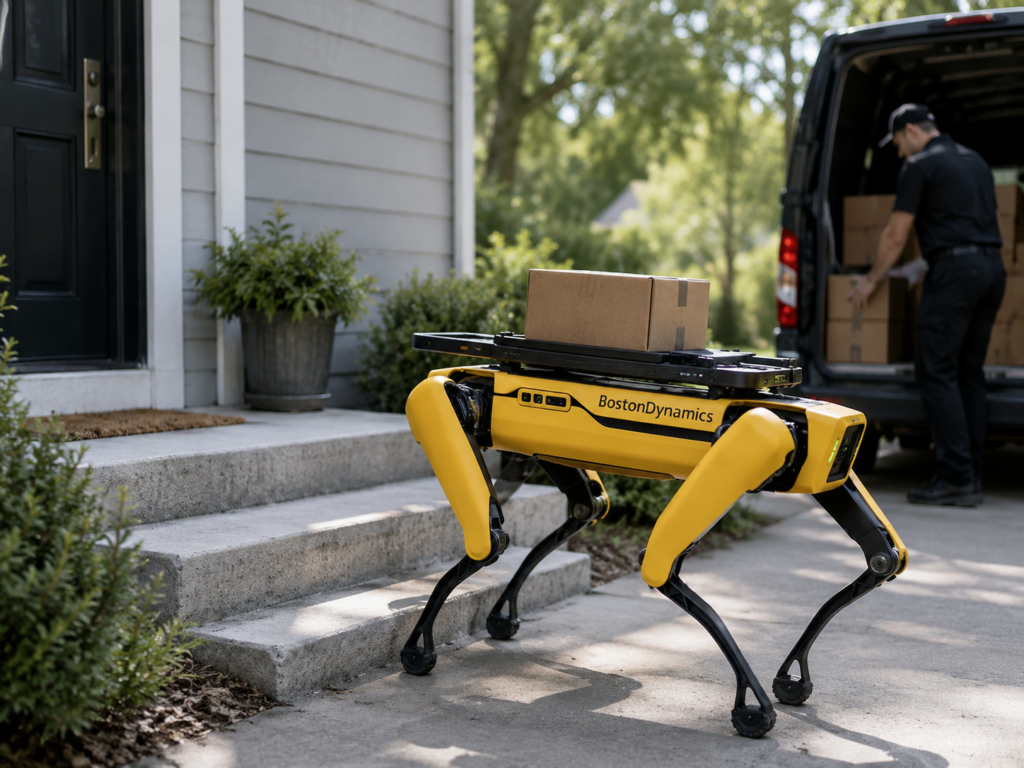
Boston Dynamics is testing a new job for Spot, its well-known four-legged robot. This time, the robot is not inspecting a factory or entering a dangerous industrial site. Instead, Spot is carrying packages from a delivery van to a customer’s front door.
The company revealed the concept on July 14, 2026. In the demonstration, Spot carries parcels on a conveyor-style platform mounted on its back. Once the robot reaches the correct home, the attachment moves the package onto the doorstep.
At first, the idea sounds like a publicity stunt. Still, the project targets a real problem for delivery companies. The final part of a delivery route often involves stairs, steep driveways, gravel, grass, narrow paths and awkward entrances. Most small delivery robots use wheels, so they struggle with many of those obstacles.
Spot uses legs instead. So, it can cross uneven ground and climb steps that would stop a normal pavement robot.
How the Spot Package Delivery System Works
The delivery process looks fairly simple in Boston Dynamics’ demonstration. A driver stops the van near several homes and places packages on the robot’s conveyor attachment. Spot then walks to the selected address and unloads the parcel near the entrance.
The basic process works like this:
- The delivery driver parks near a group of homes.
- The driver loads one or more parcels onto Spot.
- The robot receives a destination or route.
- Spot walks across the property and avoids obstacles.
- The conveyor moves the parcel onto the doorstep.
- The robot returns to the van or meets the driver at another location.
Meanwhile, the driver can prepare the next order, organise the van or deliver another package nearby. That shared workflow matters more than full automation.
Boston Dynamics estimates that Spot could help add one extra package to a route for every three packages handled by the robot. For now, that figure remains an estimate. A real delivery trial will need to test the idea across busy routes, poor weather and unpredictable homes.
Why Boston Dynamics Chose a Robot Dog
Delivery robots already exist in several forms. For example, small wheeled machines can transport groceries and restaurant orders across pavements. Drones can carry lightweight items through the air. Yet each design faces practical limits.
Wheeled robots work best on flat, smooth routes. A raised kerb, staircase or broken path can bring the journey to a stop. Drones avoid ground obstacles, but noise, weather, flight rules and safe unloading remain serious concerns.
Spot sits between those two options. It stays on the ground, but its legs let it handle more difficult terrain.
Current Spot specifications include:
- A top speed of about 1.6 metres per second
- A maximum slope of 30 degrees
- A maximum step height of 300 millimetres
- A typical operating time of around 90 minutes
- A total payload capacity of 14 kilograms
- An IP54 protection rating
The payload figure includes the equipment attached to the robot. So, the conveyor system reduces the remaining weight available for packages. Boston Dynamics has not announced the final parcel weight limit for the delivery version.
Even then, the robot should still handle many small and medium packages. Heavy furniture, large appliances and bulky orders will stay with human delivery teams.
Spot Will Assist Drivers, Not Replace Them
The most realistic version of this system keeps a human driver in control of the route. Spot handles the repeated walking and carrying between the van and the property.
Delivery workers do far more than move parcels. They scan labels, follow access instructions, contact customers, manage signatures and deal with locked entrances. They also make quick decisions about parking, pets, traffic and damaged packages.
Spot does not replace those skills. Instead, it takes over a narrow physical task.
That difference makes the idea more believable. A driver could park once near several houses. Spot could carry one package up a long driveway, and the driver could walk to another home with a separate order.
At the same time, the robot could reduce some of the strain linked to carrying boxes throughout a long shift. That benefit may matter most during busy shopping periods, when delivery volumes rise sharply.
Robot Legs Could Close the Doorstep Gap
Boston Dynamics calls the space between the road and the front door the “porch gap.” It sounds small, but this part of the route has stopped many delivery robot projects.
A wheeled robot may travel through an entire neighbourhood, then fail at the first staircase. A drone may reach the correct property, then struggle to find a safe place to leave the order.
Spot has a better chance of reaching the doorstep. It can walk over grass, climb steps and move around garden furniture. It can also adjust its balance on uneven ground.
Still, no robot can handle every home. Loose dogs, closed gates, icy steps, deep snow and crowded paths can create problems. Heavy rain may cause trouble too. Spot carries an IP54 rating, which means it can resist dust and splashing water, but it is not built for flooding or extreme storms.
The unloading system needs careful control as well. A soft parcel may handle a short drop. A camera, glass item or fragile electronic device may not.
So, delivery companies will need clear rules for package size, weight and contents. They will also need to check the surface where the robot plans to leave the parcel.
Safety and Privacy Could Decide Whether People Accept It
A robot dog walking through a neighbourhood will get attention. Some residents will stop and watch. Others may feel uneasy when a machine fitted with cameras approaches their home.
Spot needs cameras and terrain sensors to move safely. So, delivery companies must explain what the robot records, how long the data remains stored and who can view it.
Physical safety matters just as much. The robot must react correctly when a child runs across its path, a pet approaches it or a vehicle reverses nearby. It also needs a safe response when a gate closes or a walkway becomes blocked.
Package security creates another challenge. Someone could interfere with the robot or try to remove a parcel before it reaches the right address. A customer may also approach the machine before the unloading process finishes.
For that reason, a commercial system will need live tracking, remote supervision and automatic alerts. Those features will add cost, but they will be hard to avoid.
The Cost Question Is Still Open
A robot can work well and still fail as a business tool. Delivery companies will compare the cost of Spot with the time it saves on each route.
The final calculation will include:
- The purchase or rental cost of the robot
- Conveyor hardware
- Battery replacements
- Charging equipment
- Repairs and maintenance
- Software fees
- Staff training
- Remote support
- Insurance
Route design will shape the result. Spot could save time in neighbourhoods with long driveways, steep entrances and homes close together. It may offer little value on streets where drivers can park directly beside each door.
Battery life presents another issue. A typical 90-minute operating time will not cover a full delivery shift. So, a van may need spare batteries or a charging system.
Cold weather, heavy packages and repeated stair climbing may shorten the runtime too. That means Spot may only work during selected parts of a route.
Boston Dynamics Already Builds Robots for Logistics
Package handling is not new for Boston Dynamics. The company already sells Stretch, a warehouse robot designed to unload boxes from trucks and shipping containers.
Stretch works inside logistics centres. Spot brings automation closer to the customer.
The full process could look like this:
- Stretch unloads packages at a warehouse.
- Sorting systems send each parcel to the correct route.
- Human drivers move the orders through towns and cities.
- Spot carries selected packages from the van to the doorstep.
This model uses each machine for a task that suits its design. Warehouse robots handle repeated box movement. Spot deals with difficult ground. Human workers manage driving, customers and unexpected problems.
The same pattern appears across many new hardware stories. Early demonstrations can look finished long before a product reaches normal users. Tech readers following other developing products can see a similar gap between reports and confirmed details in the latest Canon EOS R8 Mark II rumors.
Is Boston Dynamics Ready to Launch Robot Dog Deliveries?
Not yet.
Boston Dynamics has shown that the idea can work in a controlled setting. The company is also speaking with large logistics businesses about possible trials. Still, it has not named a delivery partner, pilot city, launch date or price.
For now, Spot package delivery remains a working concept.
A real test will need to measure far more than walking ability. Logistics companies will study delivery speed, maintenance costs, battery use, safety incidents and customer reactions.
Reliability will matter most. A robot that saves five minutes on one stop but needs frequent human help will not improve a route.
Yet the concept has a clear advantage. Spot already does the hardest physical part well. It can walk across ground that stops wheeled robots.
What Robot Dog Delivery Could Mean for Customers
Customers should not expect Spot to appear outside their homes soon. Delivery trials often start in small areas and run for months before a company decides whether to expand them.
The first public service may look quite ordinary. A delivery van could arrive as usual. A human driver may stay nearby, and Spot may carry only certain parcels to homes with long paths or steep steps.
That setup feels far more practical than a completely driverless service.
Spot can take on repeated walking and lifting. The driver can manage the route and deal with customers. Together, they may complete more stops with less physical strain.
The project still faces questions about price, safety, privacy and reliability. Even so, Boston Dynamics has chosen a task that fits Spot’s strengths.
The robot does not need to replace the whole delivery system. It only needs to make the final few metres faster and easier.