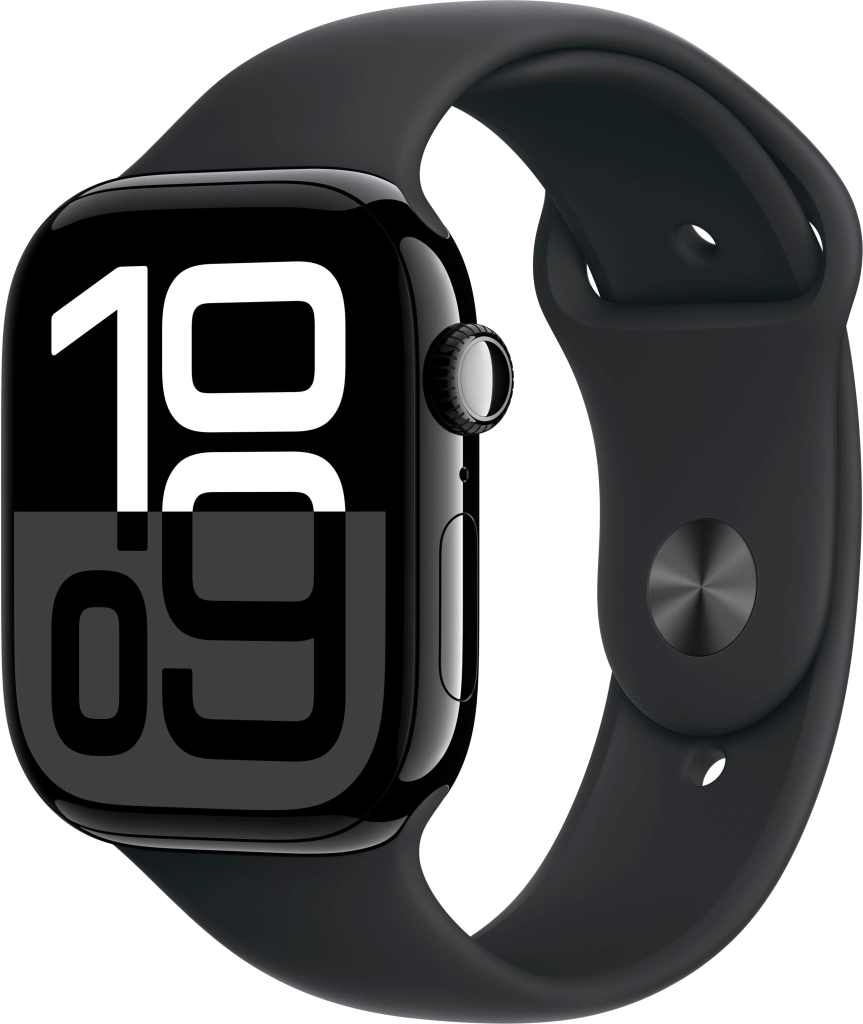
Apple Watch Series 11 review
This review measures the Apple Watch Series 11 against the full 32-spec sheet we track for smartwatches, comparing it like for like with the 28 other models in our database. It earns a VS Score of 49 out of 100 — the weighted result of every verified specification measured against the class average.
On the spec sheet it is strongest in software and weakest in battery. Its clearest single advantage over the class average: 20.37 GB more onboard storage — 64 GB vs 43.63 GB (avg). Street prices currently start at $ 329.99 for the Apple Watch Series 11.
Category strengths
Where the Apple Watch Series 11 beats the average
- Has blood pressure ?
- Has ECG ?
- 20.37 GB more onboard storage ?64 GB vs 43.63 GB (avg)
- Has Wi-Fi ?
- 8.02 g less weight ?34.6 g vs 42.62 g (avg)
- Has sapphire glass ?
- 0.27 " more display size ?1.96 " vs 1.69 " (avg)
- Has skin temperature ?
- Has wireless charging ?
- Has NFC payments ?
Where the Apple Watch Series 11 trails the average
- 95.48 h less battery life ?24 h vs 119.48 h (avg)
- No dual-frequency GPS ?
- 1.11 ATM less water resistance ?5 ATM vs 6.11 ATM (avg)
- 431.03 nits less peak brightness ?2,000 nits vs 2,431.03 nits (avg)
- 0.13 less Bluetooth version ?5.3 vs 5.43 (avg)
Specifications
Quality bars are generated automatically against 28 other smartwatches.
Design
A lighter watch is more comfortable to wear all day.
The case diameter; larger cases fit bigger displays, smaller ones suit slimmer wrists.
The case material (e.g. aluminium, titanium).
A higher ATM rating allows swimming and diving.
Shows the time and stats without raising your wrist.
A scratch-resistant sapphire crystal protects the screen.
The case and band colour options the watch is sold in.
Display
A larger display is easier to read and interact with.
A higher pixel count produces sharper text and graphics.
The screen technology (e.g. AMOLED).
A brighter screen is easier to read in sunlight.
Health & fitness
Continuously tracks your heart rate.
Measures blood-oxygen saturation.
Takes an electrocardiogram to check heart rhythm.
Estimates blood pressure from the wrist.
Monitors sleep stages and quality.
Tracks routes and distance without a phone.
Senses skin temperature for health insights.
Detects hard falls and can call for help.
More tracked workout types suit more activities.
Battery
Estimated hours of use between charges.
Tops up quickly from empty.
Charges on a wireless pad or puck.
How long a full charge takes; lower is better.
Connectivity
A newer Bluetooth version improves range and efficiency.
Connects to Wi-Fi for updates and sync without a phone.
L1+L5 GPS gives more accurate tracking in cities and forests.
Make calls and stream without your phone nearby.
Pay contactlessly from your wrist.
Take calls and use a voice assistant on the watch.
Software
The watch software platform.
More storage holds more offline music and apps.
How the VS Score works — and what it can’t tell you
Every measurable spec is scored against the average of all the smartwatches we track: matching the class average scores 50, clearly beating it climbs towards 100, and each spec counts according to an editorial weight that reflects real-world impact — a battery-capacity gap moves the score far more than a colour-options list. The quality bars on the spec cards above show where this model sits inside the full range for its class, and the overall VS Score rolls every weighted result into one number.
Unknown values are never estimated. A spec this product doesn’t report simply drops out of its scoring — it isn’t penalised with a guess — but a thinner spec sheet does mean a score built on fewer data points, which is why completeness is disclosed under About this data.
Most importantly: a spec-sheet lead is not the same as a better product. Megapixels, gigahertz and benchmark points describe capacity, not experience — image processing, software optimisation, thermals, haptics and ergonomics decide how a device actually feels, and no table captures reliability or long-term support quality. Treat the VS Score as a structured summary of what can be measured, not a substitute for your own priorities.
About this data
- Specifications are compiled from each manufacturer’s official spec sheet, cross-checked against trusted specification databases, and normalised into one schema so identical things are compared identically.
- Specifications last verified July 8, 2026.
- Data completeness: 31 of the 32 specs in this category are verified (97%). Anything we could not verify is shown as Unknown — never estimated — and is excluded from the score.
- Prices and availability come from live retailer feeds via our shopping partners and refresh throughout the day; a missing price means no partner currently lists the product, not that it is discontinued.
- Want the full picture? Our editorial guidelines explain how we research products, weight the scores and stay independent.
- Spotted an error in a spec? Tell us and we will correct the sheet.
Where to buy
Prices and availability may change. Check the retailer before buying. We may earn a commission on purchases.
Price history
Smartwatches with similar specs to the Apple Watch Series 11
Ratings & reviews
Feature ratings
- A polished everyday smartwatch, but not a major upgrade
The Apple Watch Series 11 feels like a refined version of an already excellent smartwatch. The display is bright, sharp, and easy to read outdoors, while the slim case feels much more comfortable than larger sports watches. I can wear it throughout the day without noticing it too much, although the comfort still depends heavily on the band.
Battery life is better than on older Apple Watch models, and I can usually get through a full day and track sleep without worrying about an immediate recharge. However, it still needs charging more frequently than many Garmin or other dedicated fitness watches. Fast charging helps, especially when I place it on the charger while getting ready in the morning. Apple officially rates it for up to 24 hours of normal use and up to 38 hours in Low Power Mode.
Health and fitness tracking are among its strongest features. Heart-rate monitoring, workout tracking, ECG, sleep stages, sleep score, and the Vitals app provide useful information in one place. Some health features depend on the country, eligibility, and software configuration, so they may not be available to every user.
The biggest weakness is that the upgrade may feel fairly small for anyone who already owns a recent Apple Watch. It also remains closely tied to the iPhone, and the price becomes harder to justify if you only need notifications, step counting, and basic workout tracking.
Overall, the Series 11 is an excellent everyday smartwatch for iPhone users. It is comfortable, responsive, and packed with useful features. However, owners of a Series 9 or Series 10 may not find enough changes to justify upgrading immediately.
Pros- Bright and responsive display
- Comfortable, slim design
- Excellent health and fitness tracking
- Fast and reliable iPhone integration
- Convenient fast charging
Cons- Battery still requires frequent charging
- Limited value for recent Apple Watch owners
- Only works with an iPhone
- Some health features vary by region
- More expensive than basic fitness trackers
No reviews match this filter.
The bottom line
The Apple Watch Series 11 earns a VS Score of 49, a solid mid-pack result among the 29 smartwatches we compare here. It stands out for has blood pressure, has ECG and 20.37 GB more onboard storage. Just be aware of 95.48 h less battery life and no dual-frequency GPS before you buy. Weigh those trade-offs against what matters most to you.
The VS Score is generated automatically from the weighted specifications above, measured against all other smartwatches in our database. Treat it as a shortlisting guide — not a substitute for your own priorities.