
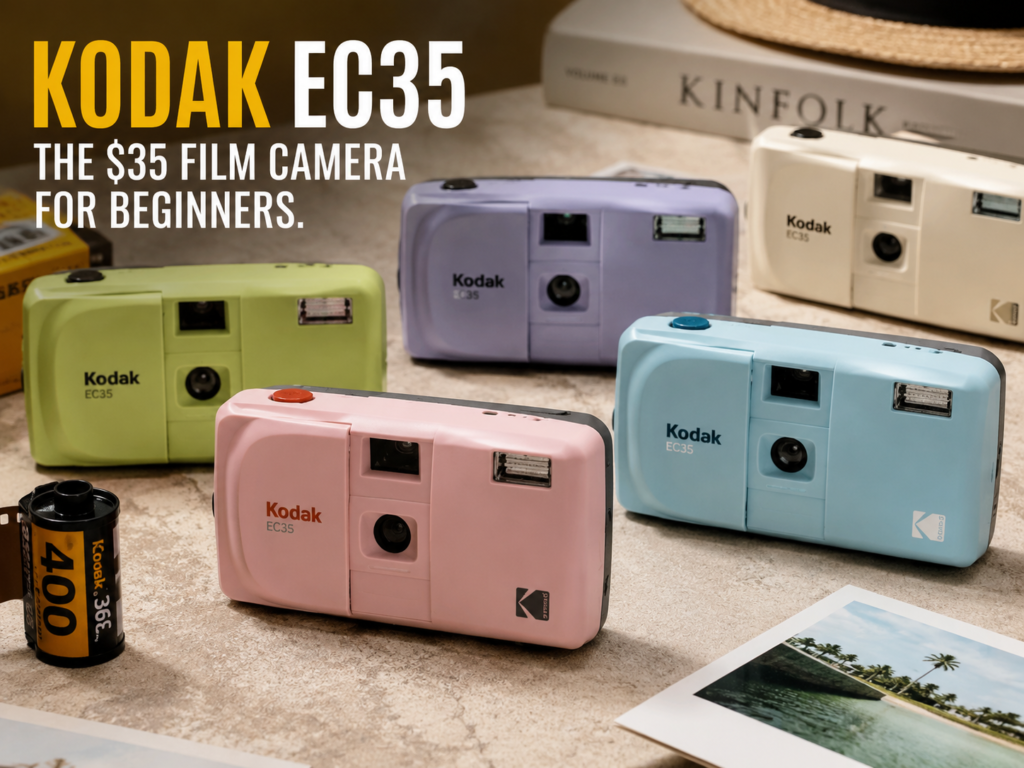
Film photography feels fresh again, especially for people who want something more tactile than a phone camera. Still, the first step can feel expensive. Used compact cameras often carry inflated prices, and older models can arrive with worn seals, faulty flashes, or unreliable film transport.
The Kodak EC35 takes a much simpler route. Priced at $34.99, this reusable 35mm camera gives beginners fixed settings, a built-in flash, and a light plastic body. There is no screen, no app, and no complicated menu.
Instead, the process stays direct. Load the film, slide the lens cover open, frame the scene, and press the shutter. Then advance the film and prepare for the next photo.
For people curious about analog photography, the EC35 looks like a friendly starting point. It keeps the learning curve low, yet it still teaches the physical steps that make film photography feel different.
A Reusable Camera at a Disposable-Camera Price
The Kodak EC35 costs about the same as many single-use film cameras. That comparison matters since the EC35 can accept a new roll after the first one ends.
The standard package includes the camera and a wrist strap. Film and the AA battery for the flash are sold separately. Some retailers sell bundles with Kodak UltraMax 400 film, though the contents vary between stores.
At first, the $35 price sounds extremely cheap. Still, buyers need to count the full cost of film photography. Every roll needs development, and most users will want digital scans or prints.
Even so, a reusable body spreads its cost across many rolls. For someone who plans to take a film camera on several trips or to several events, that makes more sense than buying a fresh disposable model each time.
The EC35 does not make film cheap. It simply lowers the cost of getting started.
Fixed Settings Keep the Camera Easy to Learn
The Kodak EC35 uses a fixed 1/100-second shutter speed, a fixed f/10 aperture, and a fixed-focus lens.
For this reason, beginners do not need to learn exposure settings before taking their first shot. The camera makes those choices automatically through its fixed design.
Next, users only need to think about light, distance, and framing. Bright conditions suit the camera best, and the flash helps indoors.
Film handling remains manual. After each photograph, the user turns the advance control. At the end of the roll, the film must be rewound into its cartridge before the camera door opens.
That process feels simple after the first roll. It teaches new users how analog photography works without adding technical controls.
There is no preview screen either. So, users cannot check focus, exposure, or framing straight away. Every shot stays a small mystery until the film comes back from the lab.
Kodak EC35 Main Specifications
The EC35 keeps its feature list short:
- Standard 35mm film format
- 25mm fixed-focus lens
- Fixed f/10 aperture
- Fixed 1/100-second shutter speed
- Two-element acrylic lens
- Built-in flash
- Manual film advance
- Manual film rewind
- One AA alkaline battery for the flash
- ABS plastic body
- 119 x 65 x 41.5mm dimensions
- 102g body weight
- Sliding front lens cover
- Wrist strap included
The AA battery powers the flash rather than the main film mechanism. So, the camera still takes daylight photos without battery power.
That design keeps things easy. There is no charging cable to pack and no battery level screen to monitor.
At the same time, users need to test the flash before an indoor event. A dead battery can leave the camera unable to light dim scenes.
The 25mm Lens Fits More Into Each Frame
The 25mm lens gives the EC35 a wide field of view. That works well for group photos, streets, buildings, landscapes, holidays, and casual indoor scenes.
For example, a photo of friends can include both the people and the setting around them. That gives the image more context and often creates a relaxed snapshot style.
Still, wide lenses need a little care with close portraits. Faces near the edge can look stretched, mainly when the camera sits close to the subject.
For a more natural result, step back and keep faces closer to the center. This small change can improve portraits without adding any technical work.
The acrylic lens will not match the sharpness of premium glass. Instead, buyers should expect softer detail, lower contrast, and occasional edge blur.
In fact, that look is part of the attraction for many film users. People often choose basic film cameras for their grain, uneven exposure, soft highlights, and less polished feel.
The Built-In Flash Matters More Than It Seems
The fixed f/10 aperture needs plenty of light. As a result, bright outdoor scenes should give the most dependable results.
Indoors, the built-in flash becomes very important. It helps at parties, family gatherings, restaurants, and evening events.
Still, a small flash has a limited range. It works best with nearby people and small groups. A distant stage, large room, or far background will often stay dark.
ISO 400 film is a sensible starting point for the EC35. It offers more flexibility than slower ISO 100 film, especially in mixed light.
Kodak UltraMax 400 fits the camera well for color photography. Black-and-white ISO 400 film can work too.
Then, users need to hold the camera steady. The fixed shutter speed handles normal movement, but fast action can still blur.
A firm grip and a gentle press on the shutter help. It sounds basic, yet those small habits can save several frames on a roll.
The Sliding Cover Adds Real Everyday Value
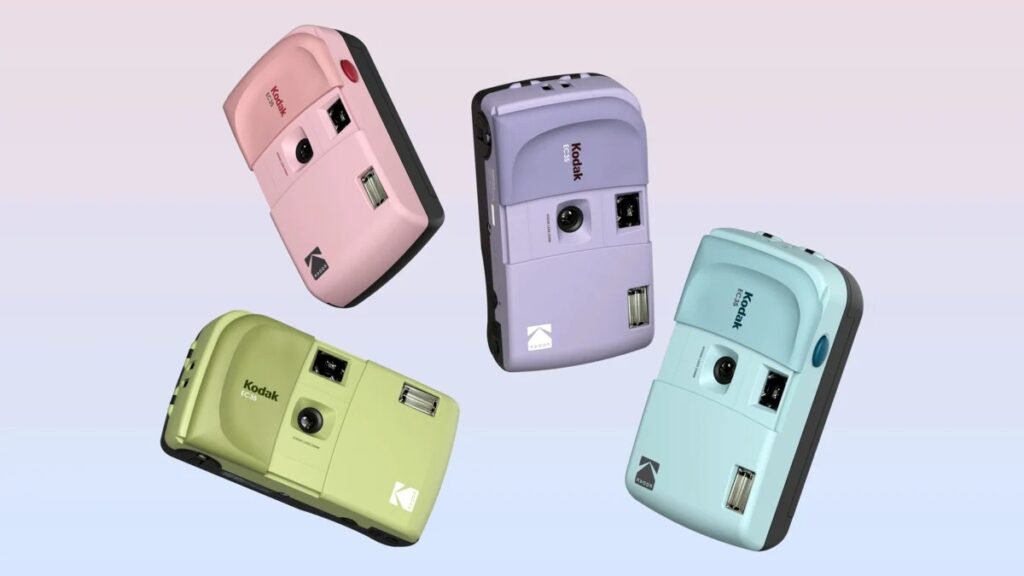
The front cover is one of the EC35’s most useful design choices.
Once closed, it protects the lens from dust, scratches, and fingerprints. It also locks the shutter, which reduces the risk of accidental photos inside a bag.
That matters with film. Every unwanted exposure uses part of the roll and still costs money to process.
Meanwhile, the cover gives the camera a neater shape. The body feels easy to store, and the lens stays protected without a separate cap.
At only 102 grams, the EC35 is light enough for a handbag, jacket pocket, backpack, or travel pouch.
For this reason, it works well as a casual second camera. People can carry it without replacing their phone or bringing a heavy camera bag.
Seven Colors Give the Camera a Playful Look
The Kodak EC35 comes in seven colors:
- Midnight Black
- Vanilla White
- Butter Yellow
- Lavender
- Powder Blue
- Blush Pink
- Avocado Green
The color range gives the camera a more personal feel than many basic film models.
For example, the black version looks simple and understated. The pastel colors feel more playful and suit buyers who want the camera to stand out.
That styling should appeal to students, younger photographers, travelers, and gift buyers.
At the same time, the specifications remain identical across every color. The choice comes down to appearance rather than performance.
Full-Frame 35mm Film Uses More Space Per Photo
The EC35 uses a normal 35mm frame. A 36-exposure roll should provide about 36 photographs, apart from any frames lost during loading.
By comparison, half-frame cameras split one standard frame into two smaller images. That can double the number of photos on one roll.
The EC35 gives each image the full film area. As a result, scans and prints can hold more detail than similar photos taken with a basic half-frame camera.
Still, the cost per photograph is higher. A half-frame model stretches one roll further, which can help people who shoot often.
The EC35 suits buyers who want the traditional 35mm format. Half-frame cameras make more sense for users focused on saving film.
Film and Development Remain the Main Expense
The $34.99 camera price grabs attention, but the complete film experience costs more.
A beginner still needs:
- One roll of 35mm film
- One AA alkaline battery
- Film development
- Digital scans or printed photos
- A small case or pouch, where needed
Processing prices vary by laboratory. Some labs charge separately for development, scans, higher-resolution files, and prints.
After a few rolls, the total film and processing cost can pass the price of the camera itself.
Even so, that does not make the EC35 poor value. The camera offers a cheap entry point. The continuing expense comes from the medium itself.
That distinction matters for beginners. The body is affordable, but regular film photography still needs a budget.
Who Will Get the Most From the Kodak EC35?
The EC35 suits people who want a simple, low-pressure film experience.
It fits:
- First-time film photographers
- Students
- Holiday photography
- Parties and weddings
- Casual street photos
- Fans of disposable-camera images
- Travelers who want a light backup camera
- Buyers looking for a low-cost creative gift
Experienced photographers can enjoy it too. A fixed-setting camera removes the urge to adjust every detail and encourages faster, more spontaneous shooting.
Still, the EC35 is not built for precise focus, manual exposure, premium optics, or strong low-light performance.
People who want those features need a more advanced compact camera. Interest in simple film models now sits beside wider camera discussions, including current Canon EOS R8 Mark II rumors among digital photography fans.
What Kind of Results Should Beginners Expect?
The EC35 will not produce a perfect image on every frame. Some photos will look soft, dark, washed out, or slightly blurred.
Bright daylight should bring the most consistent results. Indoor scenes need flash, and subjects should stay fairly close.
Next, film stock makes a big difference. Color, contrast, grain, and skin tones change from one film to another.
The lab matters too. Development and scanning choices can change the final look, even when the same camera and film are used.
That unpredictability is part of the fun. A roll can return with warm colors, deep grain, unusual shadows, or small flaws that make the photos feel personal.
For many beginners, those surprises are more memorable than perfectly clean smartphone images.
Why the Kodak EC35 Makes Sense for New Film Users
The Kodak EC35 does not try to impress buyers with advanced technology. Its value comes from simplicity.
The fixed settings remove confusion. The wide lens fits everyday scenes. The flash helps in dim spaces. The sliding cover protects the lens and reduces wasted frames.
There are limits. The lens is basic, low-light results depend heavily on flash, and film costs can build quickly.
Still, the camera matches its purpose well. It gives newcomers a direct way to learn film loading, winding, rewinding, development, and scanning.
For holidays, parties, family days, and casual travel, the EC35 looks like a sensible first film camera. It will not replace a smartphone or a premium compact model.
Instead, it offers a slower and more deliberate way to capture everyday moments. At $35, that idea feels easy to try.