
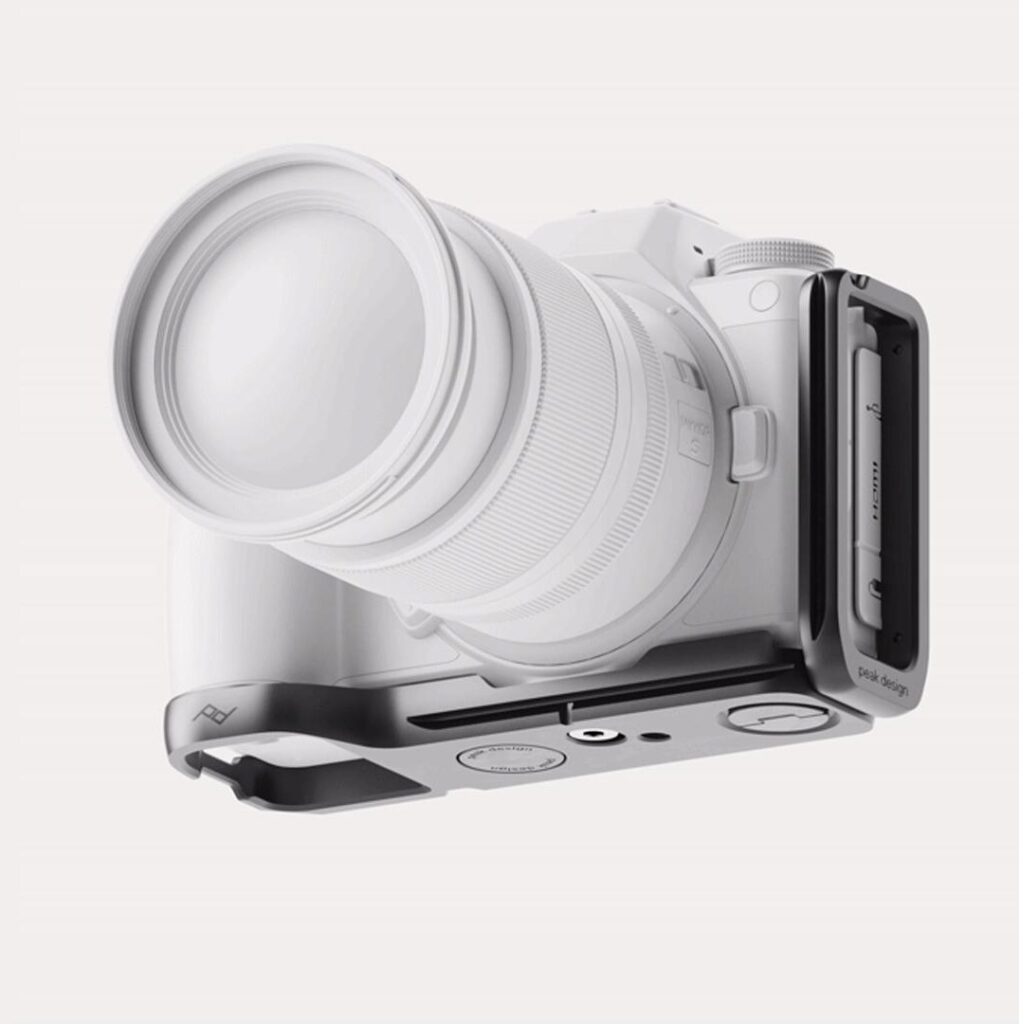
Peak Design has introduced the Field Bracket, a modular camera accessory that combines an L-bracket, tracking compartment, grip system, and expandable mounting platform. At first glance, it looks like another metal camera bracket. Yet a closer look reveals a much more flexible system.
Traditional L-brackets serve one main purpose. They let photographers switch between horizontal and vertical tripod positions without shifting the lens away from the tripod head’s center. That is useful, but most brackets do little else.
The Peak Design Field Bracket takes a broader view. Its removable sections let photographers adapt the setup for portrait shooting, handheld work, tethered sessions, and compact video rigs. Better still, the baseplate can hide an optional Beacon Finder Tag that supports Apple Find My and Google Find Hub.
That tracking feature solves a real problem for photographers who carry expensive equipment. A loose tracker attached to a strap can swing around, make noise, or attract attention. Instead, Peak Design places its tracker inside the bracket, where it stays hidden and protected.
What Is the Peak Design Field Bracket?
The Peak Design Field Bracket is a camera-specific modular L-bracket made from precision-machined recycled aluminum. Each version follows the shape of a supported camera body, so the fit should feel cleaner than a standard universal plate.
In its basic form, the Field Bracket includes a baseplate and a removable vertical upright. Together, these parts create a familiar L-bracket shape. Photographers can mount the camera horizontally or vertically on a compatible tripod head.
The connection between the two parts uses Peak Design’s Field Latch system. With this design, users can remove, attach, or reposition the upright without reaching for a hex key. That may sound like a small detail, but it can save time during a busy shoot.
For example, the upright can slide away from the camera body to create more room for USB cables, HDMI leads, microphones, or tethering equipment. Many fixed L-brackets block camera ports or press against connected cables. By comparison, the Field Bracket gives photographers more space without forcing them to remove the whole setup.
The baseplate works with most Arca-type tripod systems. It also supports Peak Design’s Capture Clip and includes mounting points for the company’s strap anchors. So photographers who already own Peak Design straps, clips, or tripods can add the bracket without rebuilding their entire setup.
The Hidden Beacon Finder Tag Is the Headline Feature
The optional Beacon Finder Tag fits inside a dedicated compartment in the Field Bracket baseplate. It supports Apple Find My and Google Find Hub, which means both iPhone and Android users can track misplaced camera equipment.
The tracker measures about 27.25 mm across and 9 mm thick. It weighs only 6.3 grams, so it adds very little bulk to the camera. Peak Design has also given it an IP67 water and dust resistance rating.
A replaceable CR2025 coin battery powers the tag. Peak Design estimates battery life at up to six months. Still, real battery life can change based on network activity, temperature, and how often the tag communicates with nearby devices.
The tracker installs from the top of the bracket. Once the camera is attached, the tag stays hidden underneath the body. That makes it harder for someone to spot or remove quickly.
Even so, buyers should view the Beacon Finder Tag as a recovery tool, not a complete theft prevention system. Bluetooth finding networks can report the approximate location of lost equipment through nearby compatible devices. They cannot stop someone from taking the camera in the first place.
For travel photographers, event shooters, and creators who move between several locations, the hidden design makes a lot of sense. It avoids the need for a visible AirTag holder or another plastic accessory hanging from the strap.
The Removable Upright Makes Daily Use Easier
A full L-bracket can feel awkward during handheld shooting. The vertical section can add width, press against the photographer’s hand, or catch on the inside of a camera bag.
Peak Design tackles that issue with a removable upright. Users can leave only the slim baseplate attached during everyday photography. Then, when they need portrait tripod support, they can reinstall the upright in seconds.
This setup feels more practical than a fixed bracket. Photographers no longer need to keep the entire L-shape attached all day. At the same time, they do not need to remove the baseplate every time they switch back to handheld shooting.
The upright can slide outward in set positions. That creates more room for an articulated display or connected cables. Studio photographers who shoot tethered should appreciate this. Hybrid creators who use external monitors or audio gear should benefit too.
In my view, the removable upright brings more daily value than the tracker. The tracking feature helps during a rare but stressful situation. The tool-free upright can improve almost every tripod session.
The Optional Cheese Plate Creates a Compact Camera Rig
Peak Design plans to offer a Cheese Plate that connects through the same Field Latch used by the vertical upright. Users can swap the upright for the Cheese Plate without tools.
The plate adds several mounting points, including 1/4-inch-20 threads, a 3/8-inch-16 connection, and cold shoe mounts. For example, photographers and videographers can attach:
- Compact LED lights
- External microphones
- Camera monitors
- Wireless video transmitters
- Audio receivers
- Small handles
- Support arms
The Cheese Plate includes 11 quarter-inch mounting positions. One of those positions can switch to a larger thread size. Its adjustable placement can create more room for ports, plugs, and cables.
This plate will not replace a full cinema cage for larger video builds. A complete cage surrounds more of the camera and offers mounting points on several sides. Instead, the Field Bracket suits smaller setups where a creator needs one or two accessories without covering the camera in heavy metal hardware.
That middle ground should appeal to many hybrid shooters. Plenty of photographers need a microphone and monitor from time to time, but they do not want to carry a complete video cage for every job.
New Hand Strap and Finger Strap Options
Peak Design has developed new handheld accessories for the Field Bracket system. Buyers can choose a Hand Strap or a smaller Finger Strap based on their camera body and preferred grip.
These straps connect directly to the bracket. Their main goal is to improve stability and lower the chance of dropping the camera during handheld use.
Peak Design recommends different strap sizes for different camera families. Larger full-frame bodies use the large Hand Strap. Smaller cameras, including the Fujifilm X100 series and Leica Q3, use the small version.
The direct connection keeps the bottom of the camera neat. More importantly, it avoids stacking several plates, loops, and strap connectors beneath the body.
Photographers who already use a neck or shoulder strap can keep their normal setup. The Field Bracket includes dedicated points for Peak Design Anchors, so the new bracket still works with the company’s existing strap system.
Which Cameras Support the Field Bracket?
Field Bracket uses a camera-specific shape. For that reason, buyers need to select the exact version made for their camera body.
Peak Design announced support for selected Sony, Canon, Nikon, Fujifilm, and Leica models.
Sony
- Sony A1 II
- Sony A9 III
- Sony A7R V
- Sony A7 V
- Sony A7 IV
- Sony A7S III
- Sony A1
- Sony A7R IV
- Sony A7C
- Sony A7C II
- Sony A7CR
Canon
- Canon EOS R6 Mark II
- Canon EOS R6 Mark III
- Canon EOS R5 Mark II
- Canon EOS R5
- Canon EOS R6
Canon photographers waiting for future bodies may find this Canon EOS R8 Mark II rumors guide useful, especially since bracket compatibility often depends on small changes to ports, battery doors, and body dimensions.
Nikon
- Nikon Z6 III
- Nikon Z5
- Nikon Z5 II
- Nikon Z6
- Nikon Z6 II
- Nikon Z7
- Nikon Z7 III
- Nikon Z8
Fujifilm
- Fujifilm X100VI
- Fujifilm X100V
- Fujifilm X-T5
Leica
- Leica Q3
Peak Design has opened a feedback form for users who want support for other camera bodies. More versions are likely to appear if enough photographers request them.
The camera-specific shape brings a cleaner fit and better port access. Yet it creates one clear drawback. Photographers who change camera bodies may need to buy a new bracket.
A universal plate costs less and can move between several cameras. Still, it rarely fits as neatly as a bracket made for one exact model.
Before ordering, buyers should check the full compatibility details. Two cameras can look almost identical but still have different screen hinges, battery doors, port locations, and body measurements.
Peak Design Field Bracket Price and Availability
Peak Design launched the Field Bracket through Kickstarter on July 21, 2026. It marks the company’s 17th crowdfunding campaign.
The planned retail price for the base Field Bracket is $149.95. Optional accessories start at $39.95. Peak Design lists the complete accessory bundle at a planned retail value of $269.80.
Early Kickstarter tiers have offered the base bracket for about $125. The full bundle has appeared at about $199. Yet crowdfunding prices, delivery estimates, and available reward levels can change during the campaign.
The Cheese Plate, Hand Strap, Finger Strap, and Beacon Finder Tag are sold as separate parts. This lets buyers choose the pieces that fit their work instead of paying for a large fixed package.
That setup keeps the starting price lower. Still, photographers who add every accessory will spend much more than they would on a simple third-party L-bracket.
Who Is the Field Bracket Made For?
The Field Bracket makes the most sense for photographers who switch between tripod work, handheld shooting, tethering, and light video production.
Travel creators may value the hidden tracker. Studio photographers may prefer the adjustable upright. Hybrid shooters may get the most use from the Cheese Plate and grip accessories.
A landscape photographer who only needs a fixed L-bracket can find cheaper options. In that case, many of the Field Bracket’s extra features may go unused.
For wedding photographers, commercial shooters, and content creators, the price feels easier to justify. These users often change setups several times during a single job, so tool-free adjustments can make a real difference.
Is Peak Design’s Modular Camera Bracket Worth Watching?
Peak Design has taken a familiar camera accessory and given it several useful roles. The hidden tracker is the feature that attracts attention, but the removable upright and modular mounting plate may bring more value during normal use.
The system will not suit every photographer. It costs more than a simple L-bracket, and its camera-specific fit limits long-term reuse. Still, the design solves several common problems in a clean way.
The Beacon Finder Tag cannot guarantee that a lost camera will return home. Yet hiding a tracker inside a useful Arca-compatible bracket is a smart idea. It adds an extra layer of protection without placing another object on the outside of the camera.
More than anything, the Field Bracket feels like a well-planned accessory rather than a collection of random features. Each part connects to a real photography need. That makes it one of Peak Design’s more interesting camera accessories in recent years.