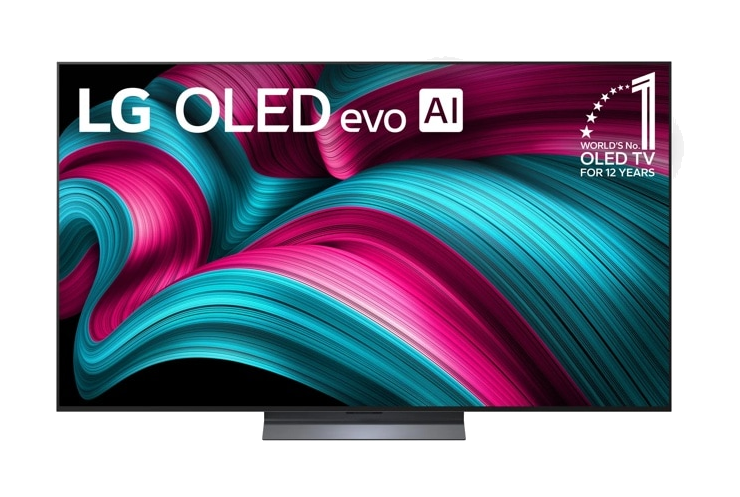
LG C5 OLED review
This review measures the LG C5 OLED against the full 28-spec sheet we track for TVs, comparing it like for like with the 32 other models in our database. It earns a VS Score of 48 out of 100 — the weighted result of every verified specification measured against the class average.
On the spec sheet it is strongest in connectivity and weakest in smart features. Its clearest single advantage over the class average: 1.42 more HDMI 2.1 ports — 4 vs 2.58 (avg). Street prices currently start at $ 1,399.99 for the LG C5 OLED.
Category strengths
Where the LG C5 OLED beats the average
- 1.42 more HDMI 2.1 ports ?4 vs 2.58 (avg)
- 16.09 Hz more refresh rate ?144 Hz vs 127.91 Hz (avg)
- Has HDMI 2.1 ?
- 1.04 more USB ports ?3 vs 1.96 (avg)
- Has FreeSync ?
- Has variable refresh rate (VRR) ?
- Has 4K 120Hz support ?
- Has Dolby Atmos ?
- Has auto low-latency (ALLM) ?
- Has eARC ?
Where the LG C5 OLED trails the average
- 1,225.65 nits less peak brightness ?1,200 nits vs 2,425.65 nits (avg)
- 1.7 less HDR formats ?1 vs 2.7 (avg)
- 2.63 ms more input lag ?13 ms vs 10.37 ms (avg)
- 9.14 W less speaker power ?40 W vs 49.14 W (avg)
- No Chromecast built-in ?
- 65.45 px less resolution ?2,160 px vs 2,225.45 px (avg)
- 0.07 " less screen size ?65 " vs 65.07 " (avg)
Specifications
Quality bars are generated automatically against 32 other tvs.
Picture
A larger screen is more immersive.
The vertical pixel count; higher is sharper (4K, 8K).
The panel technology (e.g. OLED, QLED, Mini-LED).
A higher refresh rate is smoother for sport and gaming.
Higher brightness makes HDR highlights pop.
More dimming zones improve contrast and black levels.
Wider DCI-P3 gamut coverage means more vivid, accurate HDR colour.
Support for more HDR formats means better contrast in more content.
Gaming
Carries 4K/120Hz and the latest gaming features.
Syncs the display to the game for tear-free motion.
Switches to game mode automatically.
Drives 4K at 120Hz for the smoothest console and PC gaming.
AMD FreeSync variable refresh rate for tear-free PC and console play.
Lower input lag feels more responsive when gaming.
Audio
Higher total speaker power fills larger rooms.
Adds spatial, three-dimensional audio in supported content.
Passes lossless audio to a soundbar or receiver over HDMI.
Smart features
The smart-TV platform (e.g. Google TV, webOS).
Control the TV and search by voice.
Stream from Apple devices to the TV.
Cast content from phones and laptops without a dongle.
The VESA wall-mount hole pattern (e.g. 300 x 300 mm).
Connectivity
More HDMI ports connect more devices.
More full-bandwidth HDMI 2.1 ports connect more 4K/120Hz sources.
USB ports for media playback and accessories.
The Wi-Fi generation supported; later is faster.
Pair wireless headphones or speakers.
A wired network port for stable streaming.
How the VS Score works — and what it can’t tell you
Every measurable spec is scored against the average of all the TVs we track: matching the class average scores 50, clearly beating it climbs towards 100, and each spec counts according to an editorial weight that reflects real-world impact — a battery-capacity gap moves the score far more than a colour-options list. The quality bars on the spec cards above show where this model sits inside the full range for its class, and the overall VS Score rolls every weighted result into one number.
Unknown values are never estimated. A spec this product doesn’t report simply drops out of its scoring — it isn’t penalised with a guess — but a thinner spec sheet does mean a score built on fewer data points, which is why completeness is disclosed under About this data.
Most importantly: a spec-sheet lead is not the same as a better product. Megapixels, gigahertz and benchmark points describe capacity, not experience — image processing, software optimisation, thermals, haptics and ergonomics decide how a device actually feels, and no table captures reliability or long-term support quality. Treat the VS Score as a structured summary of what can be measured, not a substitute for your own priorities.
About this data
- Specifications are compiled from each manufacturer’s official spec sheet, cross-checked against trusted specification databases, and normalised into one schema so identical things are compared identically.
- Specifications last verified July 30, 2026.
- Data completeness: 27 of the 28 specs in this category are verified (96%). Anything we could not verify is shown as Unknown — never estimated — and is excluded from the score.
- Prices and availability come from live retailer feeds via our shopping partners and refresh throughout the day; a missing price means no partner currently lists the product, not that it is discontinued.
- Want the full picture? Our editorial guidelines explain how we research products, weight the scores and stay independent.
- Spotted an error in a spec? Tell us and we will correct the sheet.
Where to buy
Prices and availability may change. Check the retailer before buying. We may earn a commission on purchases.
Price history
TVs with similar specs to the LG C5 OLED



Ratings & reviews
No reviews yet. Be the first to share your experience.
The bottom line
The LG C5 OLED earns a VS Score of 48, a solid mid-pack result among the 33 tvs we compare here. It stands out for 1.42 more HDMI 2.1 ports, 16.09 Hz more refresh rate and has HDMI 2.1. Just be aware of 1,225.65 nits less peak brightness and 1.7 less HDR formats before you buy. Weigh those trade-offs against what matters most to you.
The VS Score is generated automatically from the weighted specifications above, measured against all other tvs in our database. Treat it as a shortlisting guide — not a substitute for your own priorities.