
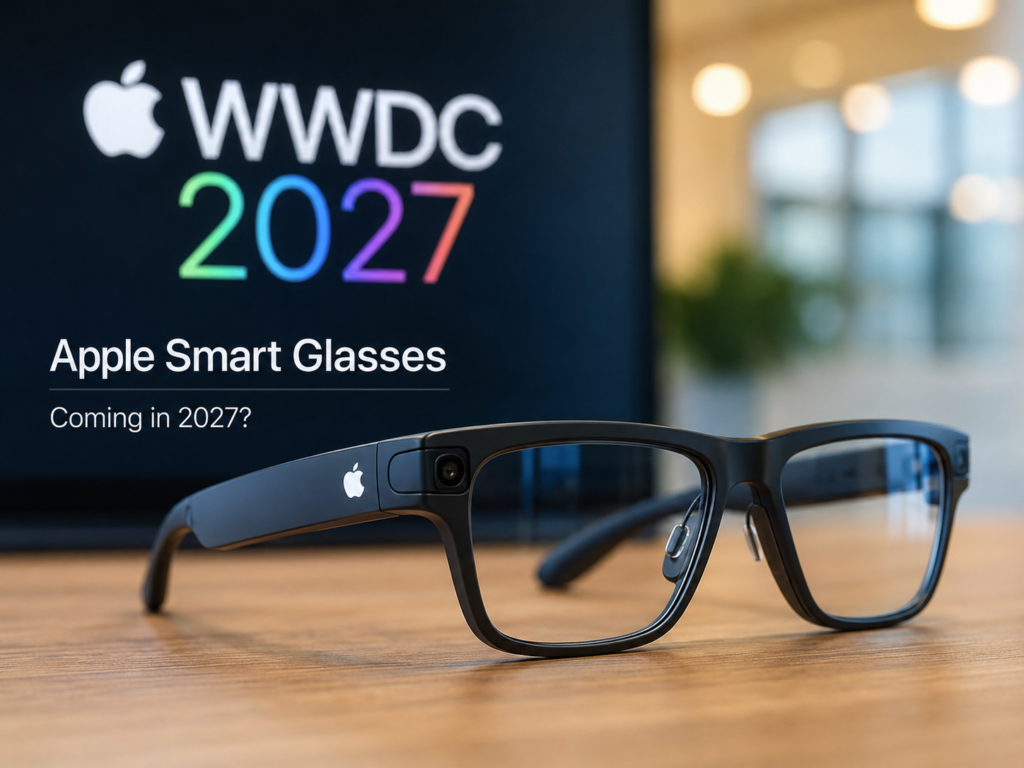
Apple may introduce its first smart glasses at WWDC 2027, giving the company a new way to bring artificial intelligence into everyday life. Recent reports point to a possible announcement in June 2027, followed by a retail launch later in the year.
Unlike Apple Vision Pro, the rumored glasses are expected to look and feel closer to regular eyewear. The first model may skip an augmented reality display and focus on cameras, microphones, speakers, Siri, and Apple Intelligence.
That choice may sound less futuristic, but it could make the product far more practical. Lightweight frames are easier to wear, and a display-free design needs less power. So, Apple may focus on useful daily features before trying to place graphics directly in front of the wearer’s eyes.
The glasses could let users take photos, make calls, listen to messages, identify objects, translate conversations, and ask questions about their surroundings. Still, the biggest challenge may not involve the technology. Apple must convince the public that camera-equipped glasses can be used without making everyone nearby feel uncomfortable.
Apple Smart Glasses Could Appear at WWDC 2027
WWDC gives Apple a fitting stage for a new wearable. The annual event often focuses on software, developer tools, operating systems, and products that need support from app creators.
Apple introduced Vision Pro at WWDC 2023, months before the headset reached stores. A similar schedule for smart glasses would give developers time to prepare apps, services, and new experiences before the public release.
Current reports suggest a June 2027 preview and a launch near the end of that year. Still, Apple has not announced the product, its name, or a release schedule. Plans can change during development, especially for hardware that combines cameras, artificial intelligence, audio, and a new form factor.
Even so, the timing feels believable. Smart glasses need close links with Siri, Apple Intelligence, the iPhone, Maps, Messages, Music, and accessibility tools. WWDC would let Apple explain how those parts work together.
What Apple’s First Smart Glasses May Include
The first Apple smart glasses may compete more closely with Ray-Ban Meta glasses than with a full mixed reality headset. Instead of placing virtual windows in front of the wearer, the product may rely on voice, audio, cameras, and AI.
Reported and expected features include:
- Built-in cameras for photos, video, and visual intelligence
- Open-ear speakers for music, calls, directions, and Siri responses
- Several microphones for voice commands and conversations
- Touch controls or small physical buttons
- Wireless iPhone connection
- Apple Intelligence support
- Siri voice control
- Visual search and object recognition
- Messaging and calling features
- Translation and accessibility tools
Apple may offer different frame shapes, sizes, materials, and finishes. Prescription lens support would make sense too, since many buyers need glasses every day rather than only for occasional use.
The company may rely on the iPhone for internet access, location data, and part of the processing. That setup could reduce heat and battery use inside the frame. It may keep the glasses lighter as well.
In practice, the product could work like a combination of AirPods, an iPhone camera, and a visual assistant. A wearer may ask about a landmark, listen to turn-by-turn directions, reply to a message, or save a photo without taking a phone out of a pocket.
The First Apple Glasses May Not Have a Display
Many people imagine Apple Glasses as a pair of advanced augmented reality glasses. In that version, maps, messages, notifications, and other digital objects would appear inside the user’s field of view.
The first model may offer a much simpler experience. Reports suggest that Apple is working on smart glasses without a built-in screen. Audio and Siri would deliver most information, rather than floating text or graphics.
That decision would solve several problems. Displays add weight, use more battery power, create heat, and make frames harder to design. They can raise the price too.
So, a display-free model may give Apple a safer entry into the category. The company can test demand, improve visual intelligence, and learn how people use wearable cameras in public.
Some buyers may feel disappointed by the lack of a screen. Yet normal-looking glasses with useful AI features may attract more customers than a heavier device that feels awkward outside the home.
Samsung appears to be targeting a similar market with its own wearable plans. Readers interested in the wider competition can learn more about Samsung smart glasses with Gemini AI, a camera, and all-day battery life.
Privacy May Decide Whether the Product Succeeds
Camera-equipped glasses create an obvious concern. People nearby may not know whether the wearer is taking a photo, recording video, scanning a room, or sending images to an AI service.
Apple has reportedly tested different privacy ideas during development. Some concepts may use cameras only for object sensing, rather than normal photography. Other prototypes may limit recording or make camera use more visible.
Possible privacy features include:
- A bright recording light that cannot be disabled
- Clear sounds during photo and video capture
- Hardware-based camera indicators
- Limits on recording length
- On-device image processing
- Restricted facial recognition
- Simple controls for deleting recordings
- No hidden recording mode
- Strict limits on AI training with customer content
A tiny light in the corner of the frame may not be enough. People should be able to see when recording starts from several feet away. Apple should make the indicator hard to cover, remove, or switch off.
At the same time, privacy rules may limit some features. That trade feels reasonable. Smart glasses will struggle in offices, schools, hospitals, restaurants, and private spaces if people see them as hidden cameras.
Apple often presents privacy as a core product value. This device would test that promise in a very visible way.
Apple Intelligence Could Become the Main Feature
Apple Intelligence may give the glasses their strongest reason to exist. The cameras could show the system what the wearer sees, and the microphones could capture spoken questions. Siri could then describe an object, read text, find information, or complete a task.
Possible uses include:
- Reading signs, menus, and product labels aloud
- Identifying landmarks and common objects
- Translating live conversations
- Summarizing visible text
- Creating reminders from voice commands
- Giving walking directions through audio
- Recognizing plants, animals, and products
- Answering questions about nearby places
- Taking a photo through a spoken request
- Sending messages without touching an iPhone
These features could be especially useful for people with visual impairments. Reading text, identifying objects, and describing surroundings may turn the glasses into a valuable accessibility device.
Still, the whole experience depends on speed and accuracy. Slow answers would become annoying. Incorrect descriptions could be worse, especially during travel or navigation.
For that reason, Apple needs reliable voice recognition, fast processing, and clear feedback. The glasses must understand context without forcing users to repeat every request.
How Apple Smart Glasses May Differ From Vision Pro
Vision Pro is a spatial computer built for immersive apps, entertainment, work, and mixed reality. It covers much of the face and includes advanced displays, eye tracking, cameras, and sensors.
The rumored smart glasses are expected to serve a different purpose. They may look like ordinary glasses and suit commuting, shopping, travelling, walking, and meeting friends.
Key differences may include:
- No immersive display in the first model
- A much lighter frame
- Longer daily wear time
- Greater reliance on an iPhone
- Fewer spatial computing features
- More focus on audio and voice
- Easier use in public
- A lower price than Vision Pro
Even so, both product lines may share technology. Apple can bring lessons from visionOS, spatial audio, visual intelligence, accessibility, and camera processing into a much smaller wearable.
Later models may gain small displays, live captions, navigation arrows, or notification previews. For now, a simpler product may have a better chance of reaching ordinary buyers.
Battery Life and Comfort Remain Difficult Problems
Smart glasses need to fit batteries, speakers, microphones, cameras, wireless chips, and controls into thin frames. Every component adds weight and uses power.
Battery life will be one of the first details buyers check. Glasses that need charging after only a few hours may feel inconvenient. Yet larger batteries would make the frame heavier and less comfortable.
Heat creates another problem. Cameras, wireless connections, and AI processing can warm the arms of the glasses near the wearer’s temples.
Comfort matters just as much. Heavy frames can press against the nose, slide during movement, and cause pain behind the ears. Apple needs several sizes and a balanced design that works across many face shapes.
Durability deserves attention too. Glasses get dropped, scratched, bent, and exposed to rain. Buyers will expect replaceable lenses, repair options, and some level of water resistance.
Apple Smart Glasses Price Is Still Unknown
No confirmed price has appeared. Any exact number remains guesswork until Apple announces the product.
Still, the company must balance premium hardware with broad appeal. A very high price may push buyers toward Meta, Samsung, or other competitors.
Prescription lenses, premium materials, storage options, and protection plans may raise the final cost. Even so, Apple should avoid pricing the glasses like a smaller Vision Pro.
A more accessible starting price would help the company attract first-time buyers and build a larger user base. It would give developers a stronger reason to create new experiences too.
Apple will likely charge more than many rivals. Buyers may accept that premium if the frames feel comfortable, the cameras work well, and privacy controls feel trustworthy.
What to Watch Before WWDC 2027
Several details will show whether Apple’s smart glasses can become a mainstream product:
- Confirmation of a WWDC 2027 reveal
- Final frame weight
- Battery life during mixed use
- Prescription lens support
- Camera recording indicators
- Apple Intelligence language support
- Siri response speed
- Compatible iPhone models
- Water and dust resistance
- Repair options
- Launch countries
- Retail price
Privacy deserves the closest attention. Apple can build polished hardware, but public trust will decide where people feel comfortable wearing it.
Apple Has a Real Chance to Make Smart Glasses Feel Normal
Apple smart glasses could become one of the company’s most interesting products in years. A WWDC 2027 introduction would mark Apple’s first serious attempt to place visual AI inside everyday eyewear.
The lack of an AR display may seem like a weakness at first. Yet that simpler design could be the right move. Lightweight glasses with clear audio, useful cameras, reliable Siri features, and strong privacy controls may fit into daily routines far more easily than another large headset.
Real challenges remain. Battery life must be practical, the frames must feel comfortable, and the price must make sense. More than anything, people nearby must know when the camera is active.
Apple needs to solve the social problem along with the technical one. A stylish frame will not matter if people feel watched.
Clear recording signals, local processing, and strict privacy controls could give Apple a strong position. If the company gets those details right, its smart glasses may become a useful iPhone companion rather than a product that owners leave at home.