
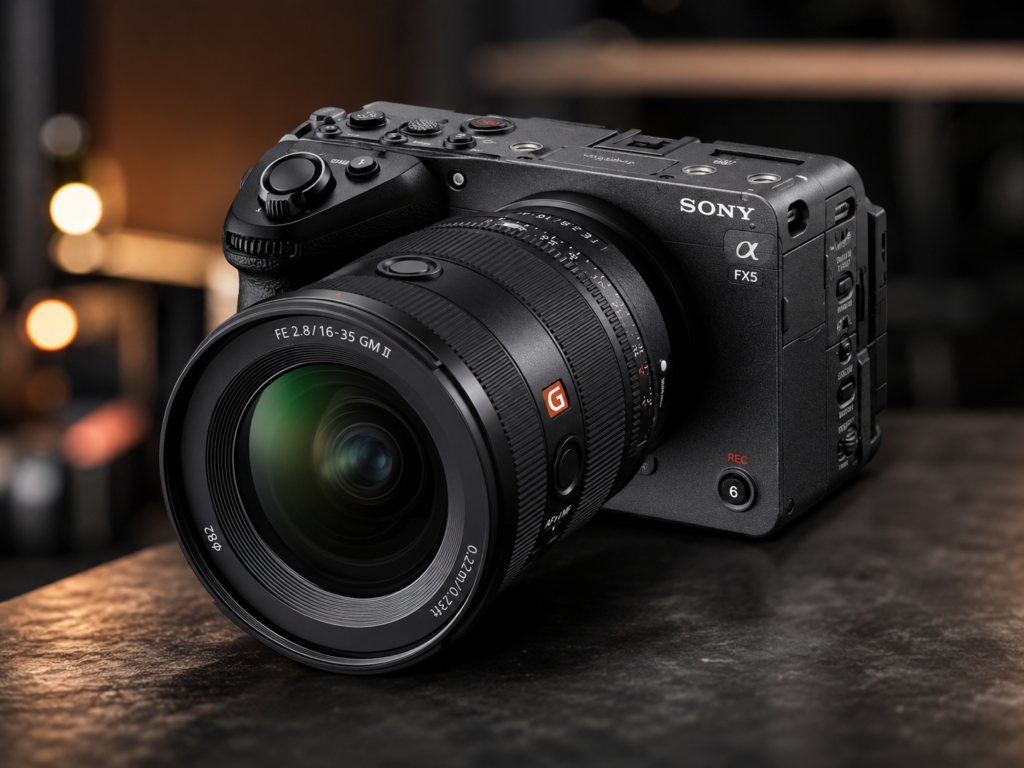
Sony has officially introduced the FX5, a compact full-frame Cinema Line camera built for filmmakers, production teams, documentary creators, and solo shooters. It sits between the smaller FX3 and the production-focused FX6, so it brings high-end cinema tools into a body that remains light enough for handheld work and travel.
For starters, the FX5 uses a new 5K stacked full-frame sensor. It supports Open Gate recording, internal X-OCN RAW, three base ISO settings, in-body image stabilisation, and AI-assisted autofocus. Sony has confirmed 4K recording at up to 240 frames per second too. Still, that feature will not be ready at launch.
At release, the camera records 5K video at up to 60 fps, 4K at up to 120 fps, and Full HD at up to 240 fps. Later, firmware version 2.0 will add 5K 120 fps and cropped 4K 240 fps recording. Sony plans to release that update in 2027.
That timing matters. Buyers who need 4K slow motion at 240 fps from day one will need to wait for the firmware update rather than rely on the launch software.
A New 5K Full-Frame Sensor Designed for Cinema
At the centre of the Sony FX5 is a newly developed 35.9 x 24 mm Exmor RS CMOS sensor. The sensor has about 18.2 megapixels in total, with up to 16.6 effective megapixels used for video recording.
Next, Sony pairs the sensor with the BIONZ XR2 image processor and a dedicated AI processing unit. The stacked sensor design supports faster readout speeds. In practice, this should reduce rolling-shutter distortion during quick pans, handheld movement, and fast action.
Sony rates the FX5 at more than 15 stops of latitude in S-Log3 under its test conditions. That gives filmmakers more room to recover highlight and shadow detail during colour grading.
The camera offers three base ISO settings:
- ISO 800 for daylight, controlled lighting, and studio work
- ISO 4000 for mixed lighting and darker indoor scenes
- ISO 12800 for low-light filming
The FX5 includes a Dual Gain Shooting mode too. This mode combines information captured at two gain levels to retain more shadow detail and reduce visible noise.
At the same time, recording format and frame rate limits still apply. Some sensor modes will not support every frame-rate option, so filmmakers will need to check their settings before a shoot.
5K Open Gate Recording Adds More Framing Options
Open Gate recording uses the full 3:2 area of the camera sensor rather than a standard 16:9 or 17:9 crop. As a result, the recorded frame includes more space above and below the subject.
That extra image area gives editors more freedom during post-production. For example, one recording can be reframed for a 16:9 YouTube video, a vertical 9:16 social clip, and a square promotional post.
This feature will appeal to small production teams that need several deliverables from a single shoot. It can reduce the need to record the same scene several times with different camera orientations.
The FX5 is the first model in Sony’s Cinema Line FX range to support full-frame Open Gate recording. The camera supports other sensor scan modes too, including full-frame 17:9, full-frame 16:9, and Super 35mm.
Still, Open Gate recording has one clear restriction at launch. It works only with Sony’s X-OCN recording format. Shooters who prefer XAVC will not receive full-sensor 3:2 recording at first.
Sony plans to add 3:2 XAVC S-I recording through the same 2027 firmware update. For now, filmmakers who want Open Gate footage will need compatible X-OCN media and editing software.
Internal X-OCN RAW Reduces the Need for Extra Hardware
One of the strongest Sony FX5 features is internal X-OCN recording. X-OCN is Sony’s 16-bit scene-linear compressed RAW format, which previously appeared mainly on more expensive cinema systems.
The FX5 supports X-OCN LT, X-OCN C1, and X-OCN C2. Each format offers a different balance between image data, file size, transfer speed, and editing demands.
For many crews, internal RAW recording can make a camera rig cleaner. There is less need for an external RAW recorder, extra cables, separate batteries, and another screen mounted on the camera.
This can make a real difference on a gimbal or shoulder rig. It can help solo operators too, since there are fewer accessories to power, mount, and monitor during a shoot.
Still, internal RAW recording does not remove every cost. X-OCN files require fast memory cards and plenty of storage space. Backup drives, card readers, and faster editing computers can raise the total cost of owning the camera.
X-OCN recording is limited to Cine EI mode. In-camera lens distortion correction is not applied directly to X-OCN clips either. Instead, compatible Sony lens metadata can be used later in Catalyst Prepare for distortion correction, stabilisation, focus breathing correction, and other adjustments.
4K 240fps Recording Will Come Through Firmware
Sony’s headline specifications include 5K recording at up to 120 fps and cropped 4K recording at up to 240 fps. Yet those maximum speeds depend on firmware version 2.0, which Sony plans to release in 2027.
The FX5 launch recording limits are:
- 5K at up to 60 fps
- 4K at up to 120 fps
- Full HD at up to 240 fps
Later, the planned update will add high-resolution, high-frame-rate X-OCN recording. Sony says the update will bring 5K at 120 fps and cropped 4K at 240 fps.
The update should bring several other tools too. These include 3:2 XAVC S-I recording, a vertical shooting interface, and a frame-grab feature.
For now, buyers should judge the FX5 by the recording modes available at launch. Planned firmware features are useful, but they are not the same as features that ship with the camera.
AI Autofocus Helps Solo Shooters Track Subjects
The BIONZ XR2 processor includes a dedicated AI unit for subject detection and tracking. The Sony FX5 can recognise people, animals, and birds, with support for eye autofocus and real-time subject tracking.
Human pose estimation helps the camera recognise a person’s eyes, head, and body. So, the system can continue tracking after a subject turns away from the camera or becomes partly hidden.
The FX5 uses up to 759 phase-detection autofocus points. That coverage should make the camera useful for interviews, weddings, documentaries, live events, and gimbal filming.
For solo creators, dependable autofocus can save time and reduce missed shots. A separate focus puller will still provide more control on larger productions. Even so, the FX5 gives smaller crews a capable built-in tracking system.
Sony has added AI-assisted light-source estimation for Auto Tracing White Balance too. The system analyses visible and infrared information to produce steadier colour under shade, indoor lights, and mixed lighting.
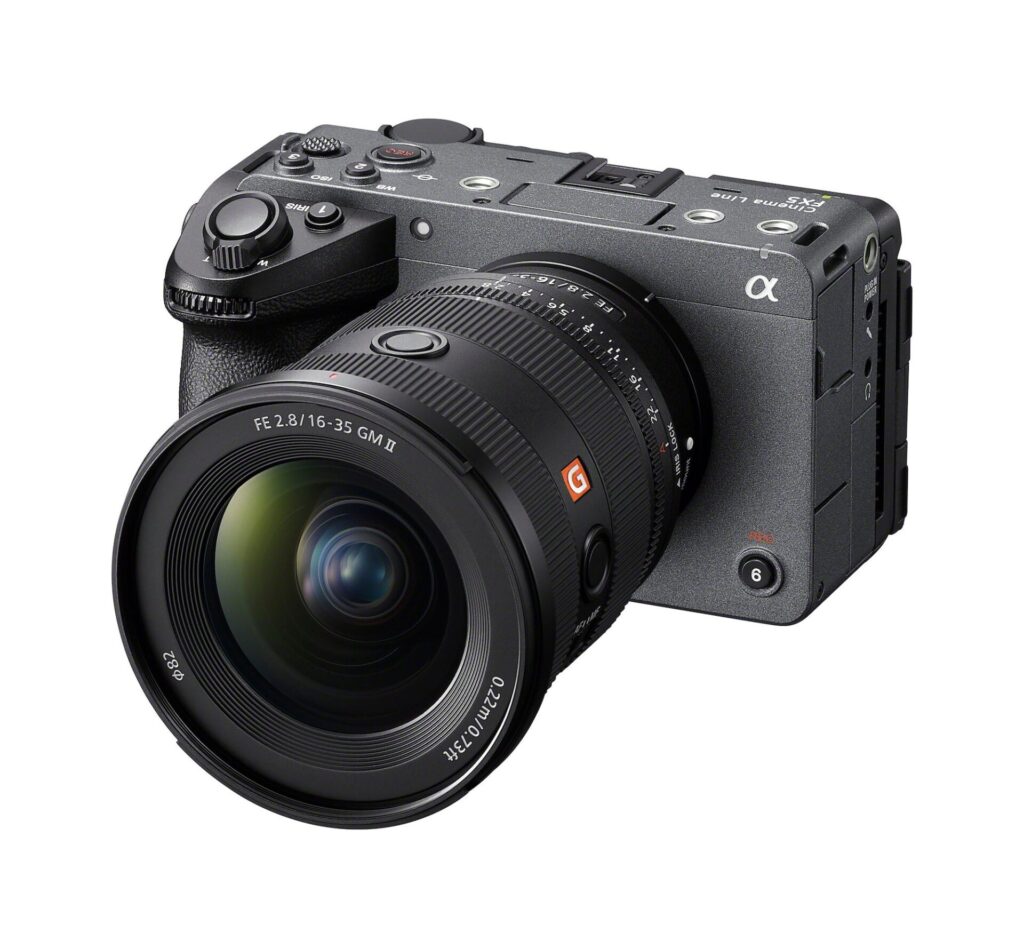
Five-Axis Stabilisation Supports Handheld Production
Unlike the FX6, the FX5 includes five-axis sensor-shift image stabilisation. Sony says the updated stabilisation unit offers about twice the roll-correction range of the system used in the FX3.
The camera provides Standard, Active, and Dynamic Active stabilisation modes. Active modes crop the image slightly, and Dynamic Active applies the largest crop.
Dynamic Active works at frame rates up to 60 fps. Standard Active mode works at up to 120 fps. Some codec and frame-rate combinations can limit the available stabilisation settings.
In practice, the system should help with handheld documentaries, wedding videos, travel projects, music videos, and fast-moving event coverage. It will not replace a gimbal for every shot. Still, it can produce steadier footage from a smaller setup.
Compact rigs are becoming more common across the camera industry. Accessories such as the Peak Design Field Bracket show how manufacturers are building lighter, more flexible mounting systems for creators who work away from a full studio setup.
Professional Controls and Flexible Monitoring Tools
The Sony FX5 has a flat-top body with several mounting points for microphones, monitors, wireless transmitters, and other accessories. In many cases, filmmakers can attach gear directly to the camera without using a full cage.
The camera weighs about 643 grams without a battery or memory card. That keeps it light enough for gimbals, drones, handheld rigs, and long shooting days.
Its 3.5-inch touchscreen has about 2.76 million dots. The four-axis display can tilt up, down, sideways, and forwards, which helps with high-angle, low-angle, and self-recorded footage.
The monitoring tools include:
- Waveform display
- False colour
- Histogram
- Focus Map
- Focus magnification
- Peaking
- User LUT support
These tools make exposure and focus checks easier on set. False colour and waveform monitoring are especially useful for filmmakers recording Log or RAW footage.
The Optional XLR Handle Adds Professional Audio
Sony offers the FX5 with an optional XLR-H2 top handle. The handle provides two XLR/TRS inputs and supports recording across up to four audio channels.
It supports audio recording at up to 96 kHz and 32-bit float. This format gives sound recordists more room to recover audio that was captured too quietly or too loudly.
The handle can make the FX5 more practical for interviews, documentaries, corporate work, and event coverage. It adds physical controls too, which are often faster to use than touchscreen audio menus.
Still, the XLR handle and optional OLED viewfinder cannot be used at the same time. Both accessories connect through the camera’s Multi Interface Shoe.
Sony sells the camera as a body-only package and as a kit with the XLR-H2 handle. Buyers who already own separate audio gear can choose the body and build their own setup.
Storage, Battery Life, and Connectivity
The FX5 has two hybrid memory card slots. Each slot supports CFexpress Type A cards or SDXC cards with UHS-I and UHS-II compatibility.
The camera supports simultaneous recording, relay recording, and separate proxy recording. Yet demanding X-OCN modes require CFexpress Type A media, so standard SD cards will not support every recording option.
Sony includes a new 2,670 mAh NP-SA100 battery. The company rates it for about 170 minutes of continuous recording or around 105 minutes of typical recording with the LCD screen active.
Two USB-C ports support data transfer, power delivery, and timecode input through an optional USB-C-to-BNC adapter. The camera includes a full-size HDMI port for external monitors and supported RAW output.
Network features include:
- 2.5 Gigabit Ethernet
- Bluetooth 5.3
- 2.4 GHz Wi-Fi
- 5 GHz Wi-Fi
- 6 GHz Wi-Fi
The FX5 works with Sony’s Monitor & Control app too. The app allows remote viewing, exposure checks, and camera control from supported phones, tablets, and computers.
Sony FX5 Price and Release Date
Sony plans to release the FX5 in the United States and Canada in mid-August 2026.
Official US pricing is:
- Sony FX5 body only: $4,899.99
- Sony FX5 with XLR-H2 handle: $5,499.99
Canadian pricing is CA$6,299.99 for the body and CA$6,999.99 with the handle.
Prices and release dates can vary by region. Buyers should check their local Sony store or authorised camera retailer for final availability.
Where the FX5 Fits Between the FX3 and FX6
The FX5 is aimed at creators who need more recording control than the FX3 offers but want a smaller body than the FX6.
Compared with the FX3, the FX5 brings Open Gate recording, internal X-OCN, a new stacked sensor, three base ISO settings, a larger display, stronger network tools, and more cinema-focused controls.
By comparison, the FX6 still offers a traditional camcorder layout and an electronic variable ND filter. Those features remain valuable for broadcast work, documentaries, and fast-changing outdoor conditions.
The FX5 has in-body stabilisation, which the FX6 lacks. It is smaller too, so it should fit more easily on lightweight gimbals, drones, and travel rigs.
The body costs less than the FX6, but the full price of a working kit can rise quickly. CFexpress Type A cards, batteries, audio equipment, monitors, storage drives, and editing upgrades can add a large amount to the final budget.
Is the Sony FX5 a Major Cinema Line Upgrade?
The FX5 looks like one of Sony’s most interesting compact cinema cameras in recent years. Open Gate recording and internal X-OCN answer two common requests from filmmakers who want flexible framing and a serious RAW workflow without carrying a large cinema body.
Its three base ISO settings, wide dynamic-range rating, AI autofocus, stabilisation, 32-bit float audio support, and strong network features make it suitable for both solo creators and production teams.
The planned 4K 240 fps mode is impressive, but it should not be treated as a launch feature. Filmmakers who need that recording speed right away should wait for firmware version 2.0 and real-world tests.
The most appealing part of the Sony FX5 is the way its features work together. Open Gate gives editors more framing freedom. Internal RAW keeps rigs smaller. AI autofocus helps solo shooters. In-body stabilisation supports handheld work.
Still, the camera will not suit every production. X-OCN creates large files, and fast media is expensive. The lack of a built-in electronic variable ND filter can matter too, especially for documentary crews working outdoors.
For filmmakers already invested in Sony E-mount lenses, the FX5 fills a clear space between the FX3 and FX6. It brings cinema-level recording tools into a compact body without losing the practical features that small crews rely on.